
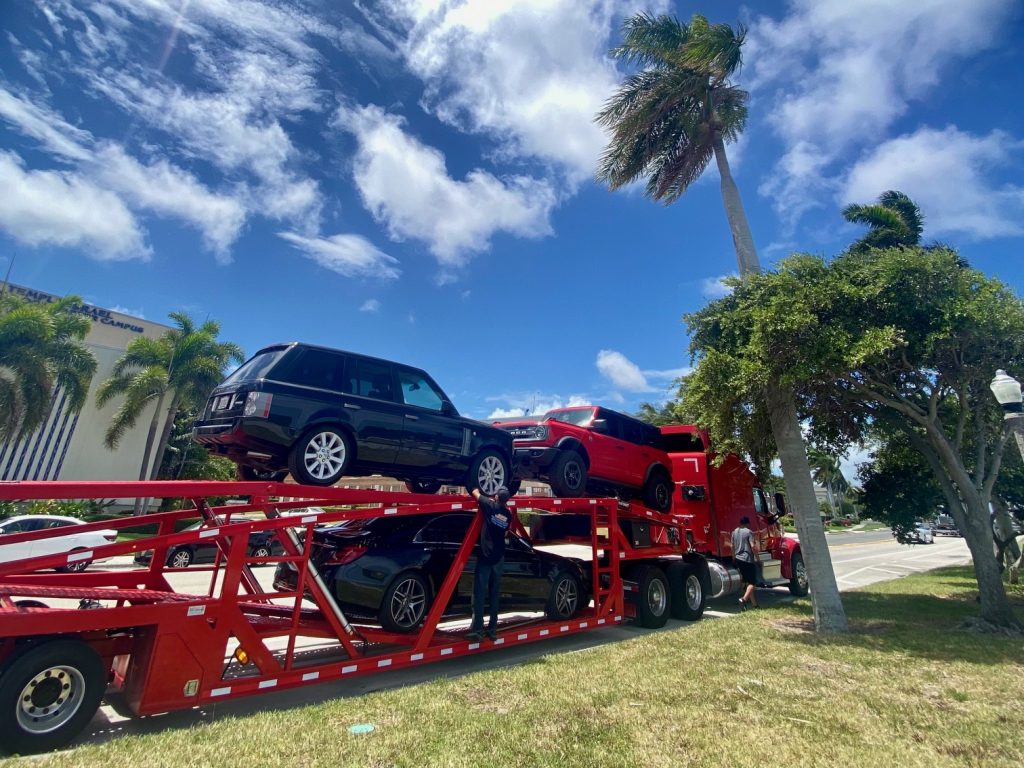
Every Fall, Thousands of Cars Head South. And Every Fall, We Have the Same Conversation.
It starts sometime around September.
And as the Fall 2026 snowbird season gets underway, the annual migration begins all over again.
The first cool mornings arrive in Connecticut. Michigan remembers that winter is coming. New York snowbirds check the calendar. Cape Cod begins winding down. Florida condos reopen, golf clubs come out of storage, and suddenly everyone has the same item on the to-do list:
Get the car to Florida.
Thousands of people want vehicles moved south at roughly the same time. Trucks fill up. Popular routes get competitive. A carrier with one remaining spot to South Florida suddenly has something valuable.
And then comes the fascinating part.
Everyone wants that spot.
Nobody wants to pay for it.
The Great $300 Psychological Experiment
Imagine you’re shipping your SUV from Greenwich to Palm Beach.
You call three auto transport brokers.
Broker #1 says $1,600.
Broker #2 says $1,400.
Broker #3 says $1,150.
Well.
Obviously, Broker #3 has discovered a secret highway the rest of us don’t know about.
Maybe his trucks run on friendship.
Maybe diesel is free on Tuesdays.
Or maybe—and stay with us here—the vehicle isn’t actually moving for $1,150.
Saving $300–$500 today feels tangible. Paying the correct market price for something that hasn’t happened yet feels painful.
So people naturally gravitate toward the lower number.
The problem is that the truck driver who actually has to drive 1,200+ miles south generally doesn’t care what number sounded nicest when you booked three weeks ago.
Then Tuesday Arrives
Your flight leaves Thursday.
The condo is waiting.
The car needs to be picked up.
And suddenly that wonderfully inexpensive shipping company has some unfortunate news:
“We’re having trouble locating a carrier at your original rate.”
Interesting.
By Wednesday, they’ve found one. Great news!
There’s just one tiny detail.
The carrier wants another $600.
Now the $1,150 shipment costs $1,750.
You’ve also spent three days making phone calls, rearranged your schedule twice, and experienced the unique joy of wondering whether your car is actually going to Florida.
Meanwhile, that $1,600 quote from a few weeks ago looks considerably cheaper.
Funny how that works.
So What Does “Market Rate” Look Like in Fall 2026?
There is no permanent price for shipping a car to Florida. Rates change with the exact cities, vehicle size, pickup window, carrier availability and demand.
But during the Fall 2026 southbound snowbird season, these are reasonable planning ranges for standard vehicles moving on open transport:
| Popular Snowbird Route | Rough Fall 2026 Open Transport Range |
|---|---|
| Connecticut → South Florida | $1,200–$1,600 |
| Long Island → South Florida | $1,250–$1,650 |
| New Jersey → South Florida | $1,150–$1,500 |
| Cape Cod → Florida | $1,300–$1,700 |
| Michigan → Florida | $1,200–$1,600 |
These are general peak-season planning ranges, not guaranteed quotes. Exact pricing depends on origin and destination, vehicle size, dates, accessibility and current carrier demand.
And that’s where the $300 mistake begins.
If trucks are consistently accepting vehicles on your route around $1,400, a broker quoting $1,050 hasn’t necessarily found you a better deal.
They may have simply given you a number the market hasn’t agreed to yet.
“But Another Company Quoted Me Less.”
We know.
They always do.
After nearly two decades in auto transport, we can practically set our watches by this conversation.
We check the route, carrier activity, vehicle, dates and destination. We give the customer a realistic number.
Someone else is $300–$400 cheaper.
We explain why we’re concerned.
They understandably choose the cheaper option.
Then, occasionally, the phone rings a week later.
“So… are you still able to move the car?”
Yes.
But unfortunately, the market didn’t get cheaper while everyone was waiting.
It got more expensive.
Michigan Has Entered the Chat
The Northeast gets much of the attention, but Michigan deserves a mention.
Detroit, Ann Arbor, Birmingham, Bloomfield Hills, Traverse City and the surrounding areas all begin feeding vehicles south at roughly the same time.
To the customer, it’s simply one car going to Naples.
To the market, it’s one of hundreds of vehicles competing for southbound capacity.
A carrier doesn’t know you’ve been coming to Naples every winter since 1997.
He sees the route, the vehicle, the pickup window and the money.
We promise he has nothing against you personally.
The Cheapest Quote Is Only Cheap If the Car Actually Moves
A legitimate lower price that gets your vehicle picked up on time?
Fantastic. Take it.
But an artificially low quote isn’t a discount.
It’s a number.
And a number doesn’t transport a car.
A truck does.
If the market is $1,500, quoting $1,100 doesn’t magically make the market $1,100.
It simply postpones the uncomfortable conversation.
One broker has it with you today.
The other has it with you while you’re packing for your flight.
Every Snowbird Season, We Learn Absolutely Nothing
Next fall, we’ll do it again.
The temperatures will drop. Florida will fill up. Thousands of cars will point south. Carrier capacity will tighten.
Someone will receive quotes of $1,600, $1,400 and $1,100.
They’ll stare at them.
And somewhere, an experienced auto transport broker will whisper:
Please don’t pick the $1,100 one.
They’ll pick the $1,100 one.
It’s human nature.
We can’t fix that.
But we can at least write this page once and send people the link. 😉
Shipping South This Snowbird Season?
Autos On The Go has been coordinating vehicle transport since 2008. We price shipments around real carrier conditions—not the number most likely to win the initial phone call.
If you’d rather know what it realistically costs to move your vehicle before moving day arrives, request a quote from Autos On The Go or call 866-924-7447.